
This season's game is BIOBUZZ, presented by RTX. It’s part of the FIRST CANOPY season, built around the energy of the natural world. The scoring elements are Pollen, 3-inch plastic balls you pick up off the field, out of walls and corners, and during autonomous. Full rules drop at kickoff on September 12, 2026. Until then we’re practicing with Pollen, running Skill Builders, and prototyping intake and drive.
We’re building a swerve drivetrain from scratch. Four modules, each steering on its own, so the robot can drive any direction without turning to face it first. Most rookie teams run tank or mecanum. That’s the sensible choice. We picked the hard one. Custom plates, odometry, and driver controls are all still being figured out, so this page changes as we design, machine, and break things.
why swerve
Three ways to move a robot around a field. We looked at all three and picked the hardest one on purpose.
Mobility
wins matches.
Four modules is four times the chance of a part being wrong. If the drivetrain isn’t reliable by our first meet, nothing else on the robot matters. So the plan is simple: one module working completely before we cut parts for the other three.
The code is genuinely harder: swerve kinematics, four steering encoders, and module offsets that all have to agree. We’d rather write it ourselves than pull in a library, though that call isn’t final.
Custom plates mean no replacement in a bag at competition. Spares for the parts most likely to fail are on the list before our first meet, and mecanum stays on the shelf as the fallback.
shift log
What we did, what broke, and what we changed because of it. The failures are the useful part, so they stay in.
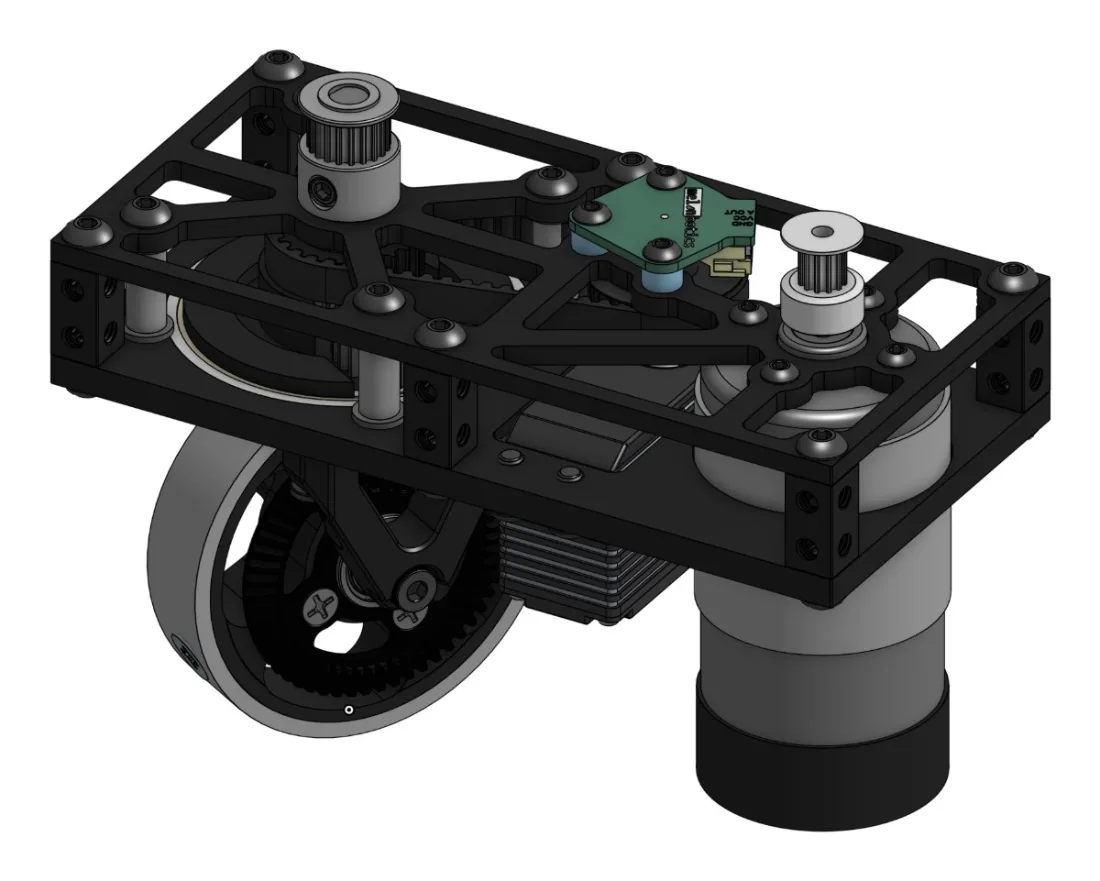
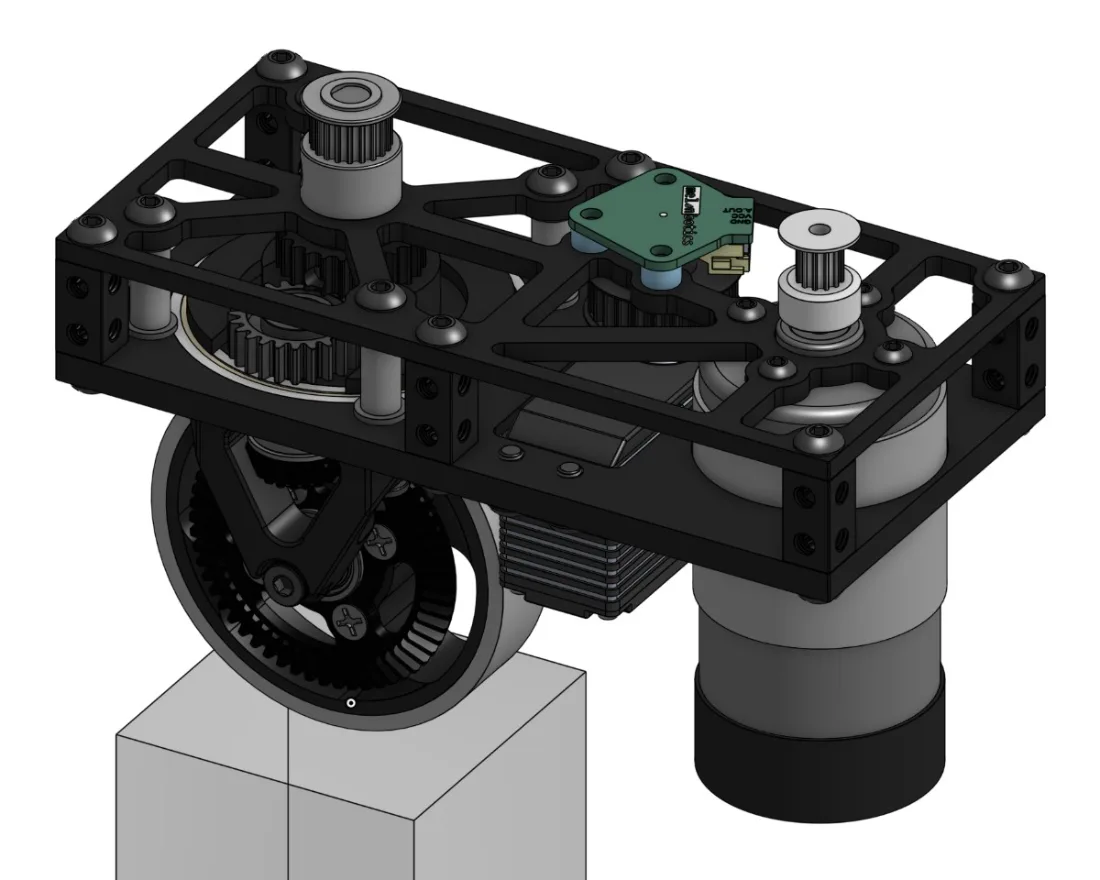
Four independent steerable modules, designed from scratch instead of bought. The first one is drawn and going together now. The CAD above is where it stands. Everything else on the robot waits on it.
in the shop
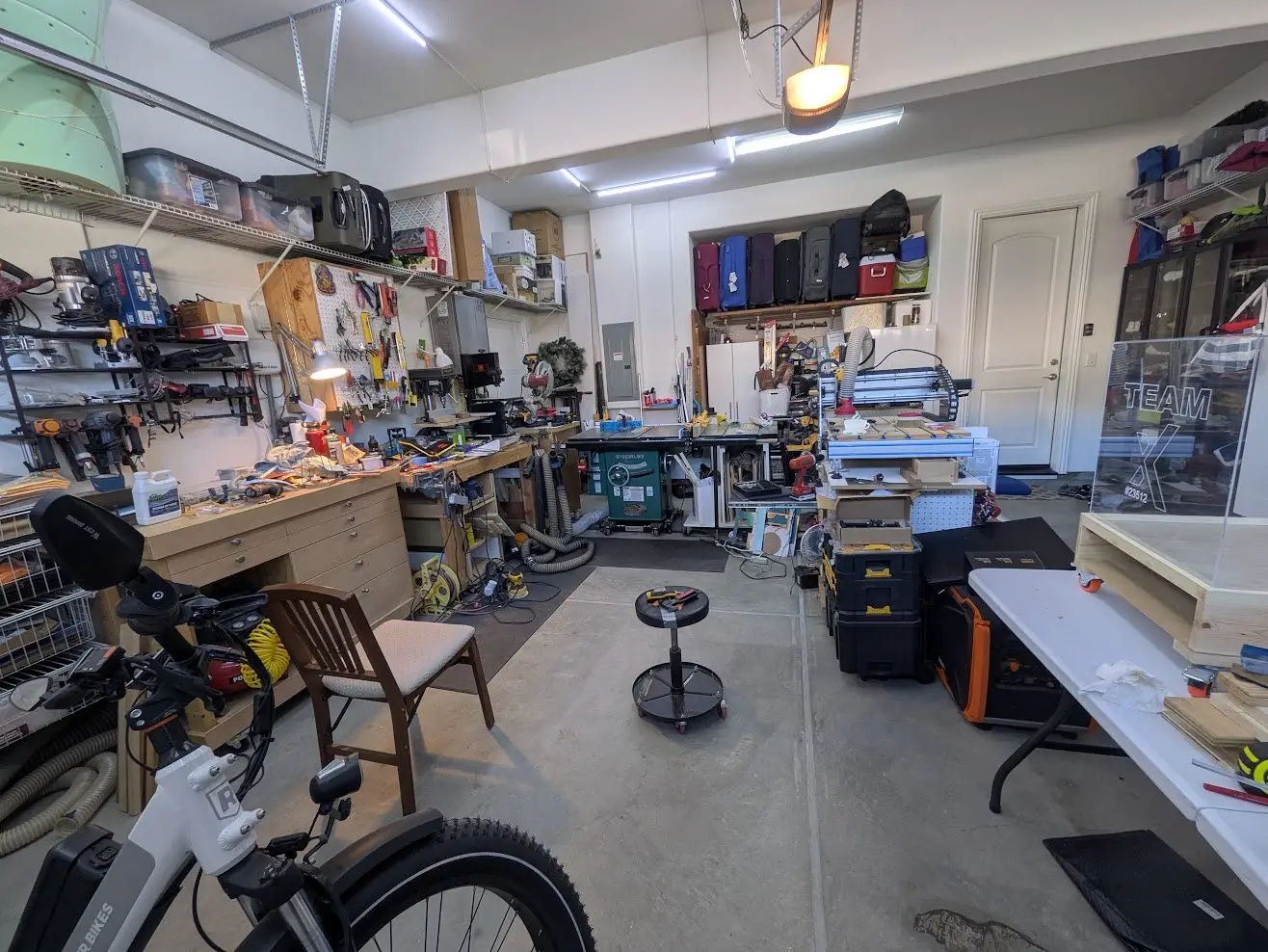
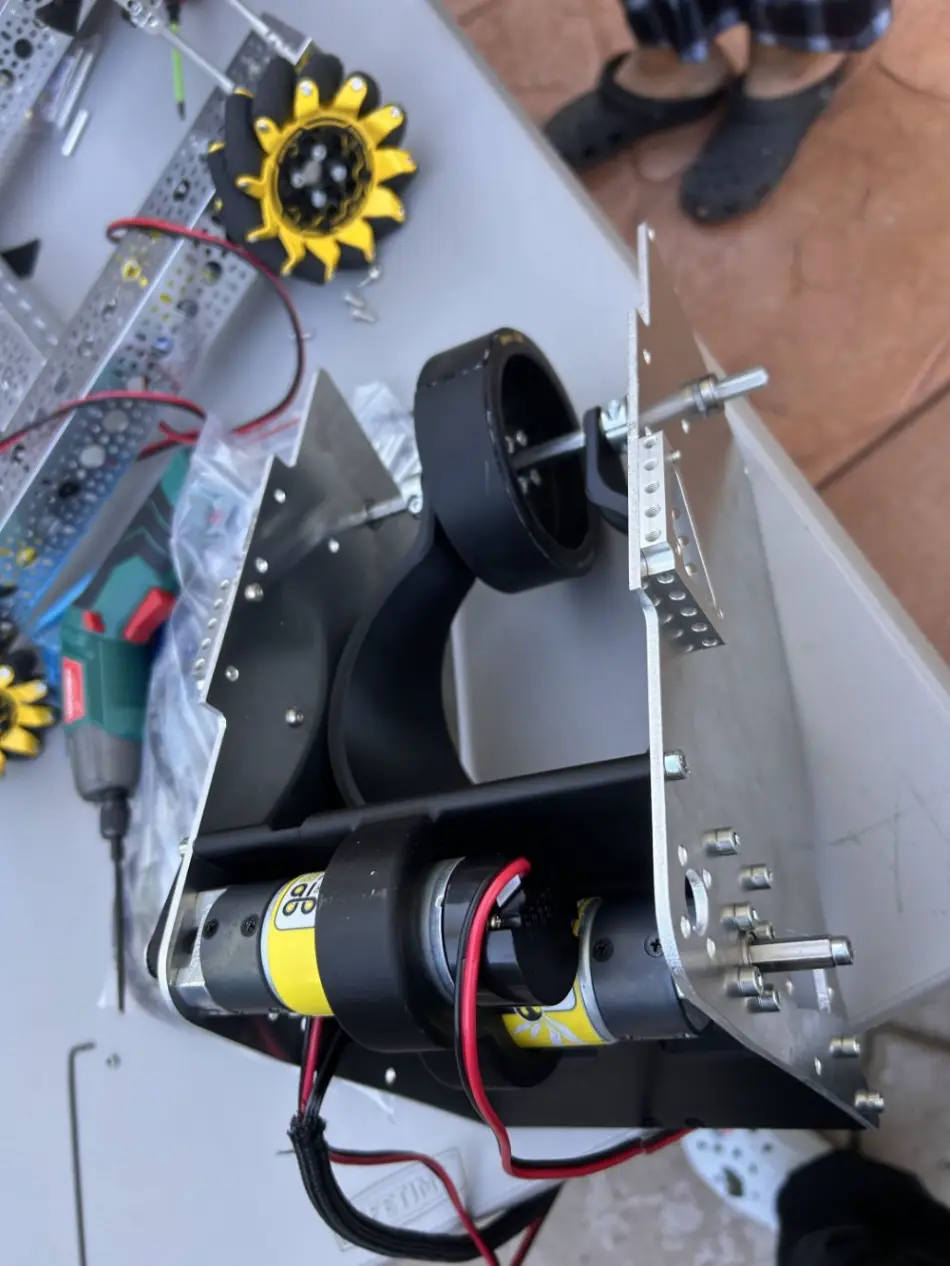
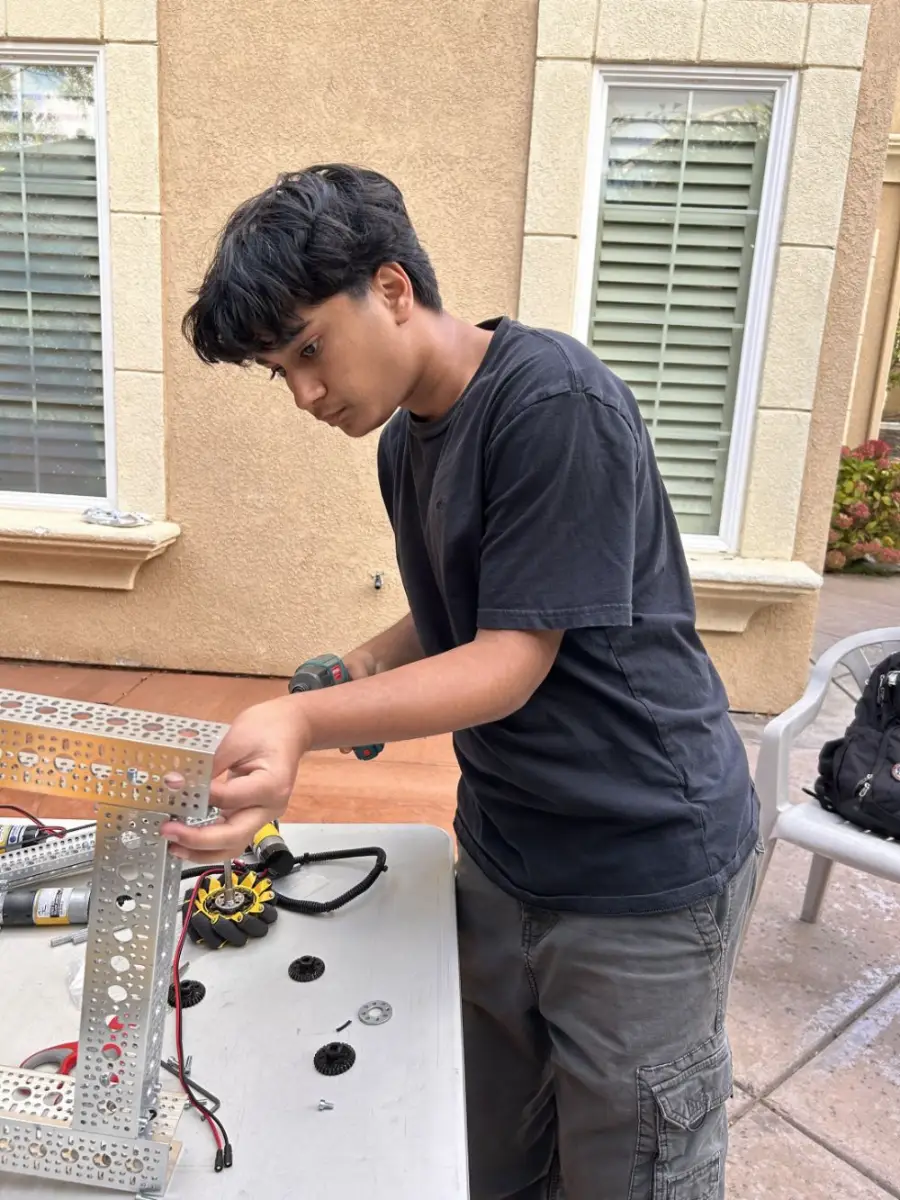
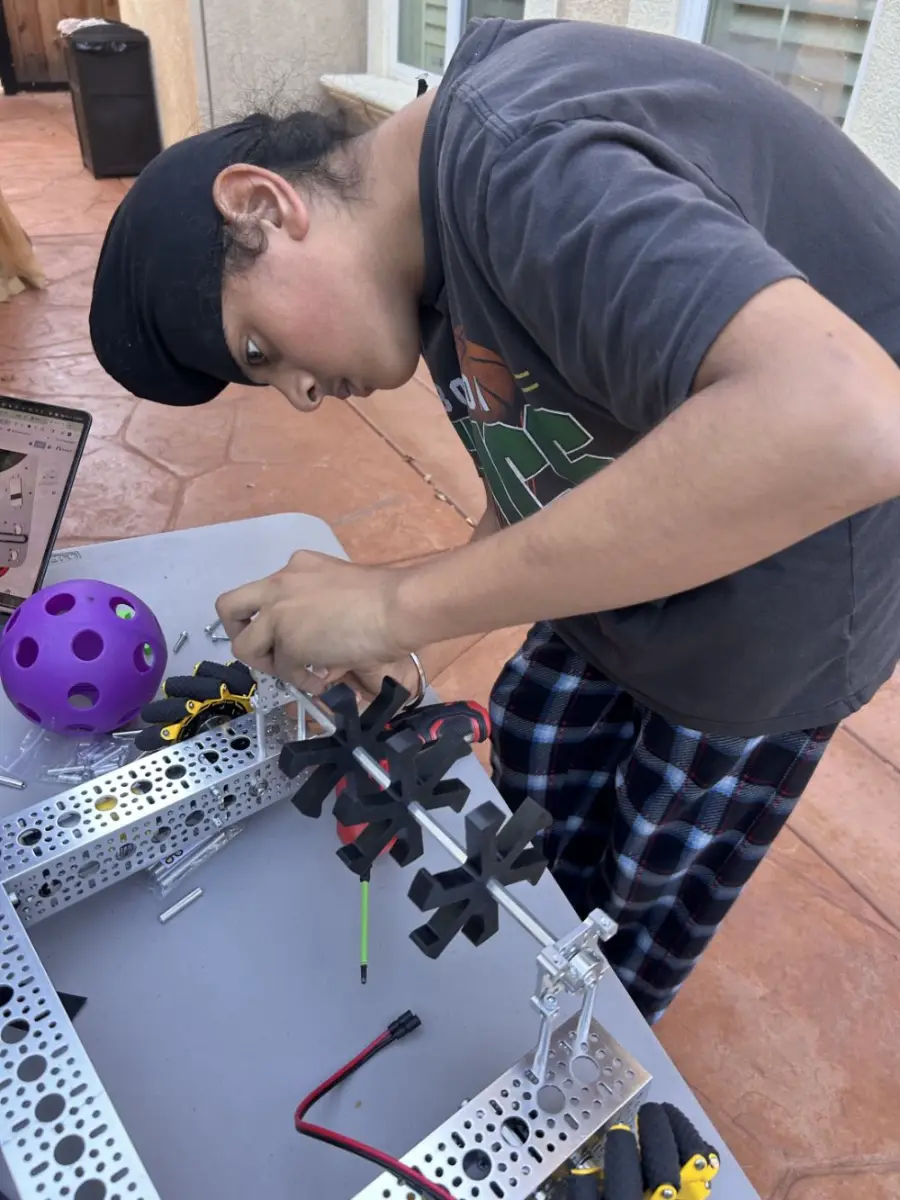
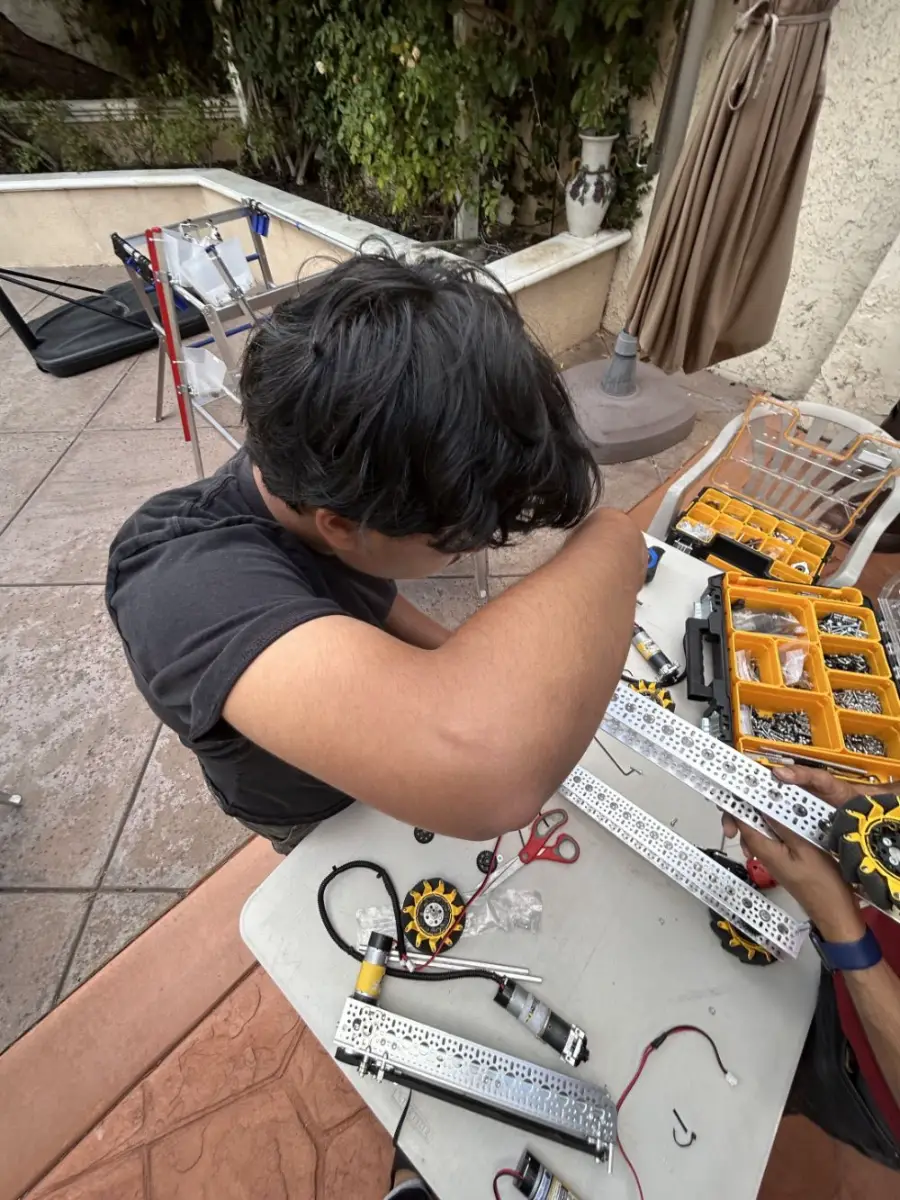
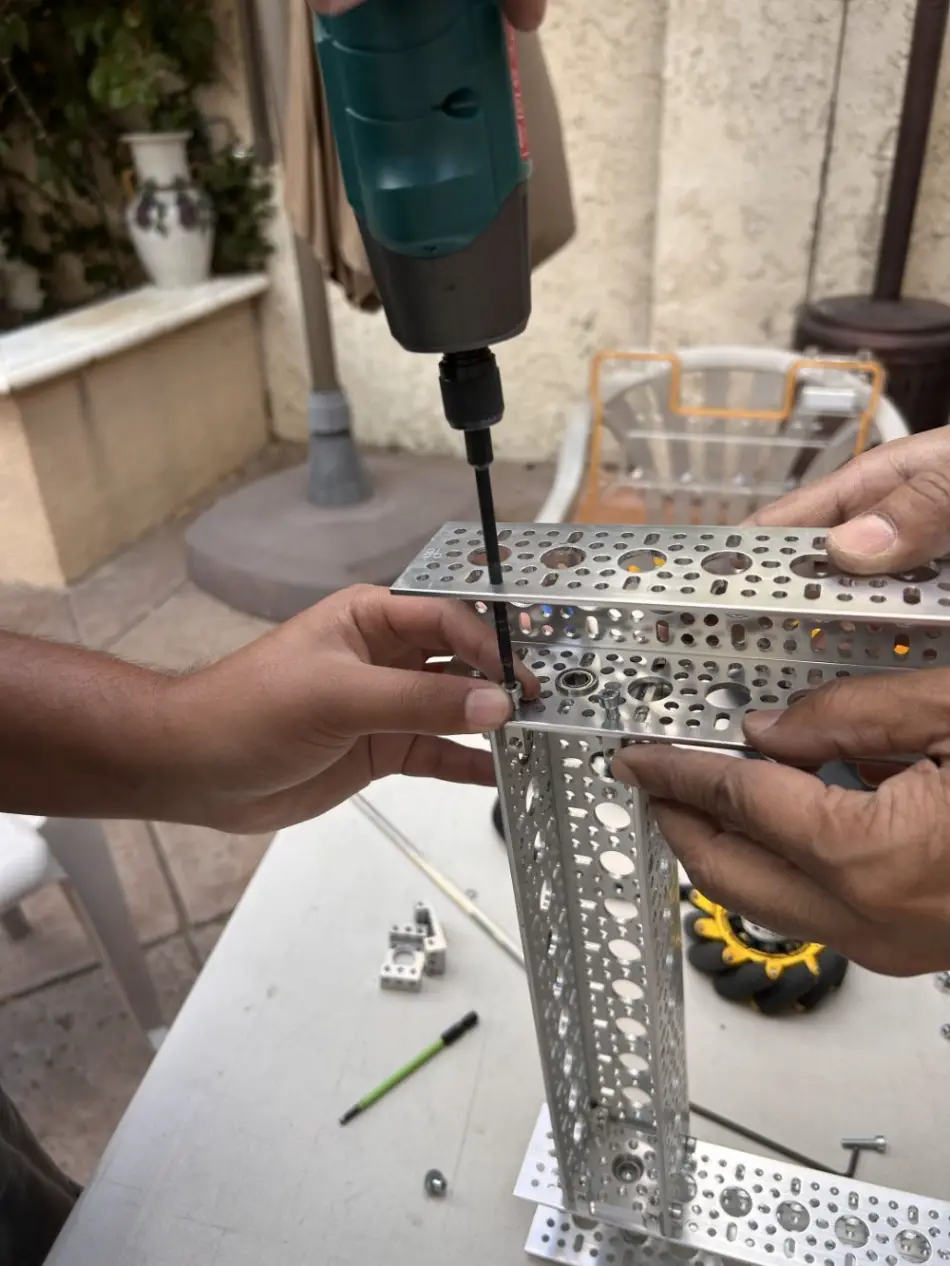
One garage, one patio table, and whatever the drill press will hold.

Two and a half minutes, counting down. Two moments decide the match.
No driver input. Tips that land during the 8 second handoff still count as auto.
Flowers cannot be scored yet. Every tip you earn releases one more Nectar from your alliance area, so tips here pay twice.
Your remaining Nectar enters the field and Flower scoring opens. Most points are scored after this mark.
Train whistle. Flower ownership can flip on the last ball, so nothing is settled until the buzzer.
the field
A 144 inch square of foam tile. One Hive sits dead centre, four Flowers are bolted to the walls. Red stands on the left as the audience sees it. Four places pay points, and they are not worth the same.
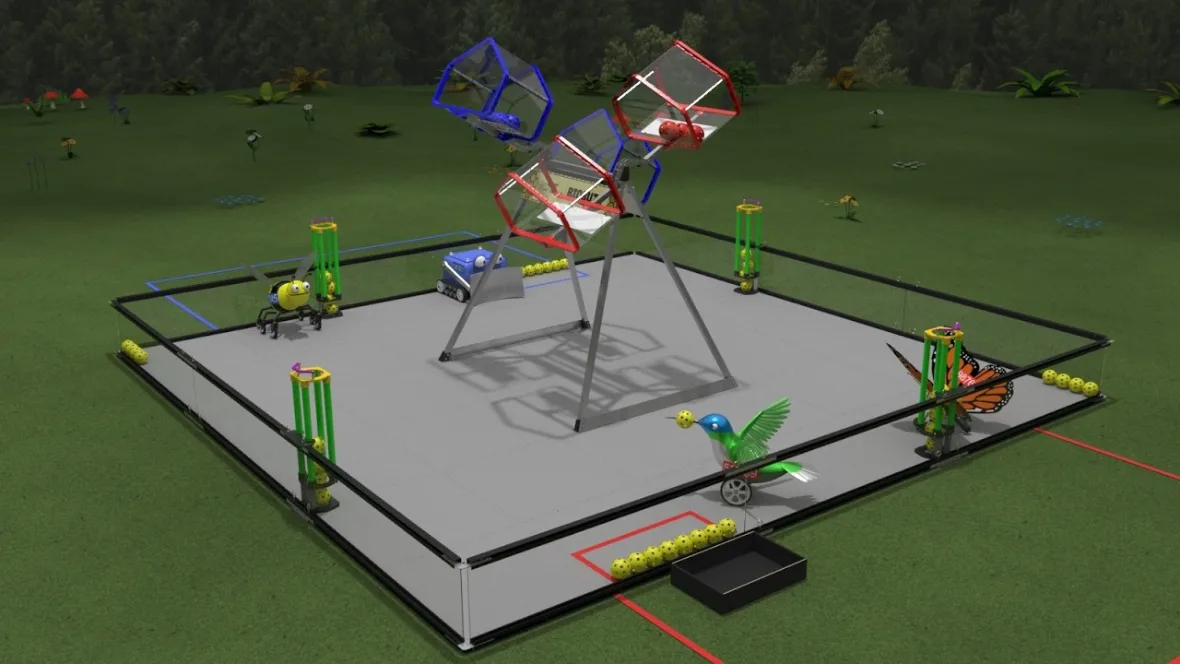
Two cells on a pivot, one facing up. Launch balls into the upward cell until it flips. A tip is 20 points, ten times anything else on the field, and it is the only way to release more of your Nectar.
Four posts on the walls. They stay locked until 1:00 remains. Own one and you score 2 points for every ball inside it, including balls your opponent put there. Your lowest Nectar in a Flower adds 5 more.
A tape strip in each of two opposite corners. Balls inside score 1 point each for that Garden’s colour, no matter who placed them. Gardens are not protected, so the other alliance can drive over and take them back out.
23 by 11 inches beside your alliance area. Finish at least partly inside it for 5 points, in auto and again in teleop. Auto pays 3 more just for driving off the wall.
how you score
Every point value in BIOBUZZ, from table 10-2 of the competition manual. One tip is worth ten balls sitting in a Flower. Build for tips.
Launch into the upward-facing Cell until the Hive flips and its damper meets the frame. Launching is the only legal way to earn one.
Finish at least partly inside your Loading Zone.
Stop touching the perimeter wall in auto. Three points for driving forward.
Your lowest Nectar in a Flower scores 5 on top of the 2 it already earns.
Counted per ball still sitting in your upward Cell when everything stops moving.
Per ball, no matter who put it there. Own the Flower and the opponent’s balls score for you.
Per ball. Gardens are not protected, so either alliance can take balls back out.
1 RP if you tie.
Leave plus park adds up to 16 or more.
Four hive tips in one match.
Seven hive tips in one match.
Fouls give points to the other alliance rather than taking yours. A minor foul is 5. A major foul is 20, which cancels a tip.
The Cell mouth is a 20 by 14 inch opening, tilted thirty degrees, sitting between 53.5 and 65.6 inches off the floor. That twelve inch band is the whole target. The Flower opening is 4 inches across at 21.5 inches up, and Nectar is 3.6 inches, so there is less than half an inch of margin.
You cannot reach 65 inches with an arm and stay inside the size limit, so this is a shooter game. We are building the launcher first. Each Cell carries four AprilTags underneath, so a camera can measure the distance instead of guessing it.
what the robot has to do
The point table turns into a short list of requirements. Everything below comes from the numbers on this page.
The Cell mouth is five feet up. A launcher is the only mechanism that reaches it inside the 18 inch starting size. This is the first thing we are building and the thing we will spend the most time tuning.
Pollen is 2.8 inches, Nectar is 3.6. Tips accept both. If the intake and the launcher only take one size, half the field is useless to you.
Balls end up loose on the tile all match. A robot that can only take a hand-off from the human player runs dry fast.
Thirty seconds of auto pays 20 for a tip and 3 for leaving the wall. AprilTags under each Cell give a camera something to range off, so the shot does not depend on where the robot was placed.
Park is 5 in auto and 5 again in teleop for finishing partly inside your zone. It is the cheapest 10 points in the game and it costs no mechanism.
Flowers open at 1:00. A 3.6 inch ball into a 4 inch hole at 21.5 inches is tight, so this is a placement problem, not a shooting problem. It is our second mechanism, not our first.
Tips only. Every tip adds a Nectar to the field for later.
Keep tipping, start claiming Flowers with Nectar.
Top off Flowers you own, then park.
the parts people miss
Four rules that are easy to miss in the game animation and change how you play.
You start with five Nectar parked in your alliance area and three in the Cell. Each tip lets your human player add one more to the field. At 1:00 the rest are released at once. Score slowly in the first minute and you end up holding balls you never get to use.
Flower scoring cannot begin until one minute remains. Score early and the ball counts, but you take a penalty. Spend the first minute on the Hive.
The Flower belongs to whoever has the top-most Nectar of their colour inside it. The owner scores 2 points for every ball in the tube. Your opponent can fill a Flower all match and lose all of it on your last shot.
Garden balls score 1 each for that Garden’s colour, no matter who placed them. The manual does not protect Gardens, so the other alliance can drive over and empty yours.
Setup is the same every match: four Pollen in each Flower, four in each Garden, four pre-loaded on each robot, three Nectar in each upward Cell, five Nectar in each alliance area. Forty Pollen on the field and eight Nectar per alliance.
the schedule
Everything on this page is a first. That’s the whole point of a rookie year.
match record
No matches yet. Our first shows up here after League Meet 1 in October. Win or lose, with the score.
the trophy case
0 awards. First season, so the case is empty. We’re going after Rookie All-Star.
Most of us got into this because somebody showed us a robot first. So this season we’re putting a group together just for outreach: running demos, setting up school visits, keeping the calendar from going empty. Kanav and Niraj are heading it up. We need more people who don’t mind emailing teachers and talking to a gym full of kids.
On the calendar: drive-the-robot nights at local libraries, STEM assemblies at middle schools around the Bay Area, workshops where kids wire a motor and write their first line of code, and a joint showcase with FTC team Olympians. We’re also planning mentorship sessions for other rookie teams. Mostly the stuff nobody warns you about until you’re already behind.
on the calendar
what we run
Kids wire it, code it, and drive it. Usually into a wall first.
Sitting in on build sessions with new teams and answering the questions we’re asking ourselves right now.
Assembly demos for younger students, with the robot doing laps behind us.
Library nights, street fairs, and maker festivals around the area.
Our own city first. Weekend drive-the-robot nights at the library, then the schools we came from.
Elementary and middle school assembly demos, once the robot is reliable enough to travel.
Any new team in the area that wants a second pair of hands on their first drivetrain.
photos
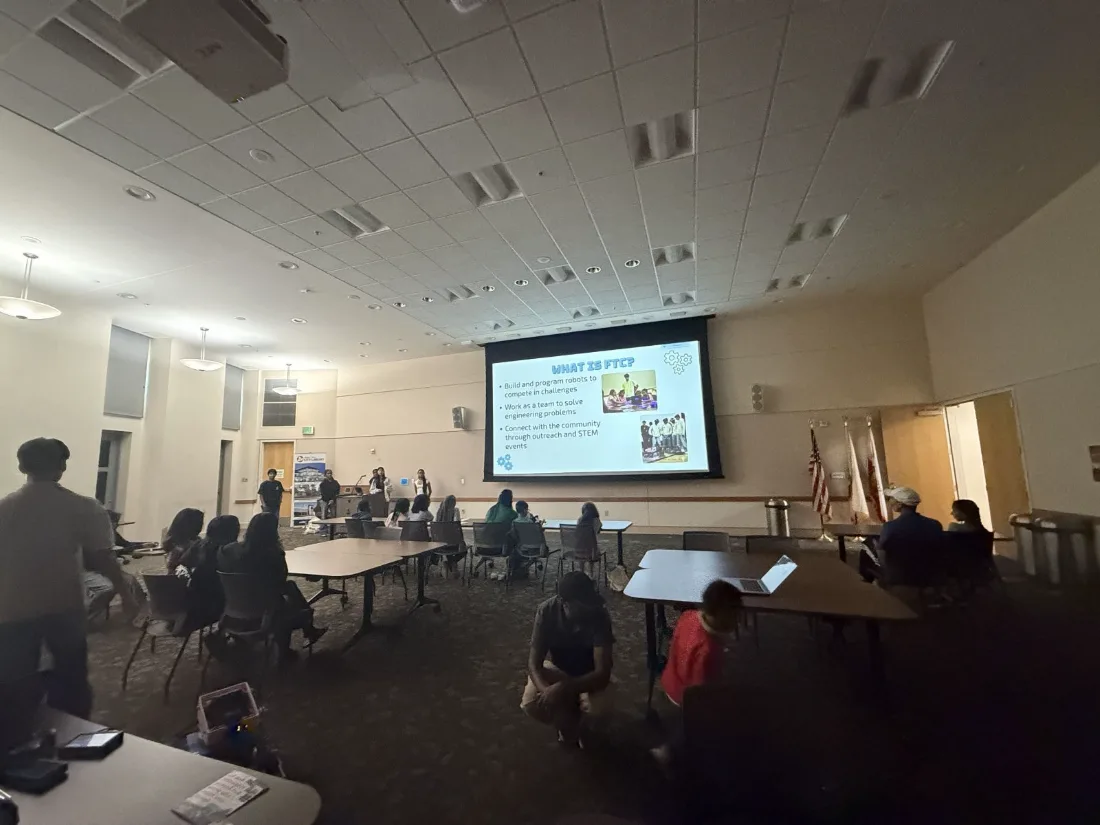
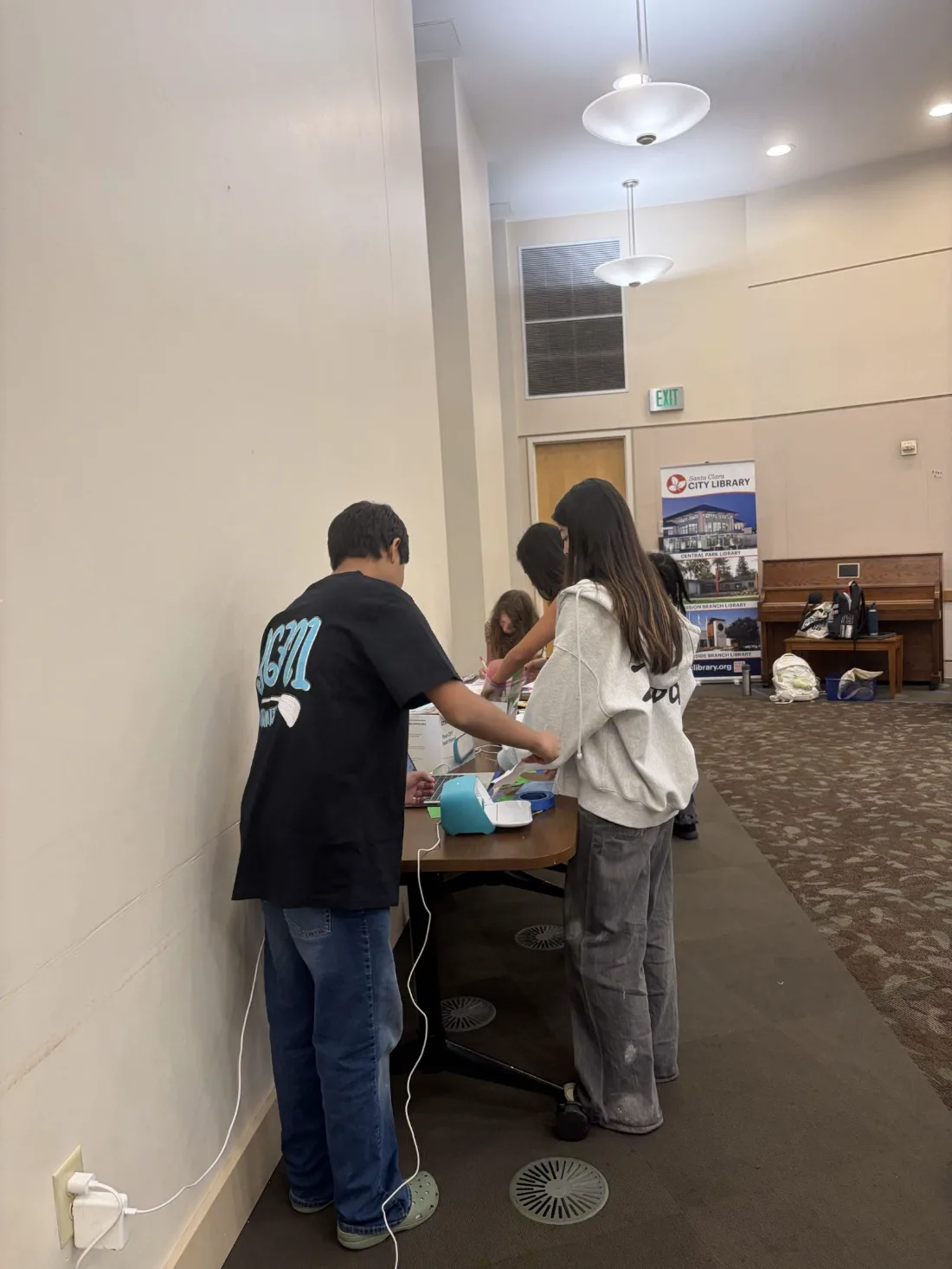
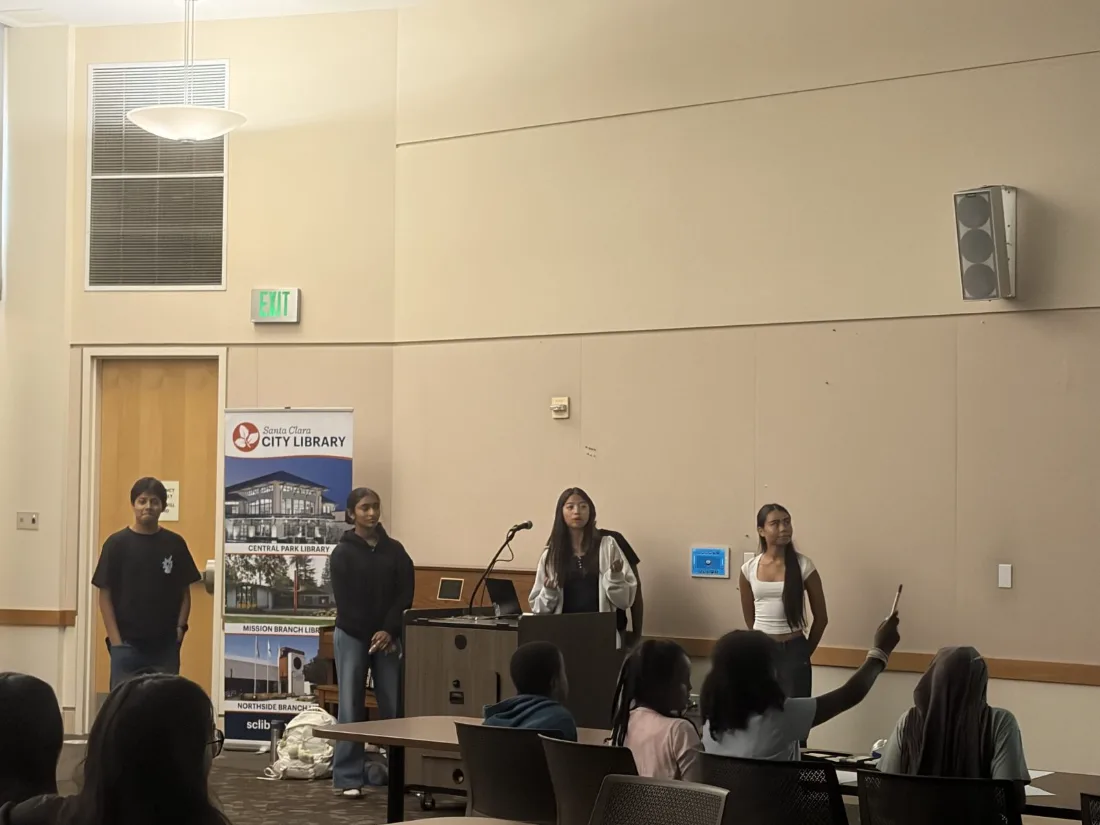
Our first one. Olympians ran the intro slides, we brought the driver station and helped at the tables. Kids asked better questions than we expected.
want us at your school?
We bring the robot, the practice field, and enough controllers that nobody waits long. An hour is usually enough.
Ask what we need, what we’d put your logo on, or where the money goes. We answer every email.
2026–27 budget
Our projected season budget is $10,000–$12,500, supporting competition, robot development, fabrication, outreach, travel, and team operations.
sponsor tiers
One-time tiers, paid through our Hack Club donation page. Custom amounts welcome. Questions about tiers or a custom amount, email us at janitorsftcteam@googlegroups.com or +1 (925) 315-6433.
Raw material. Aluminum, hardware, a set of wheels.
logo on the site
thank-you on social
Electronics. Motors, encoders, and the wiring around them.
small logo on the robot
pit banner
A subsystem. One swerve module, or the control system that drives them.
full sized logo on the robot
dedicated page on the site
A major piece of the season. Parts, entry fees, and getting to events.
named our title partner in team materials
largest logo on the robot and pit banner
It’s the team’s rookie year, not the members’.
Most of us have built and driven in FTC before. This is just the first season we’re doing it on our own.
Students run the engineering, the outreach, and the fundraising. Sponsorship goes into parts and entry fees, and in exchange your logo goes in front of every gym, library, and classroom we visit.
our sponsors
We’re a rookie team, so these spots are open. Sponsor us and your logo goes here, on the robot, and on our hoodies. get in touch.


Started coding in third grade on Python Turtle projects with my dad, and picked up four more languages since. FLL that same year, then four years of FTC as programmer and driver every season, plus a year of FRC on Team 7419. I’m here to write code and drive.
Over six years of FIRST robotics and custom projects, my early interest in making things move has turned into solid experience in CAD, prototyping, and building hardware. Serving as Team Captain, I pair these technical skills with budget & financial management capabilities to lead our team to the World Championship stage.
Eight years in FIRST, from FLL in fourth grade through four seasons of FTC. I’ve programmed and driven every season, plus CAD, electronics, and outreach along the way. Most of what I know came from building something, watching it fail, and fixing it.
I always had an interest for robotics, and I turned my passion into a real tool. I first dove into the world of FIRST last year, with FRC 7419. This year, I'm looking to use my skills in FTC, as design lead of 36721. Every mechanism on this robot starts as my CAD.
Works on design with Adarsh and runs outreach with Niraj. He handles sponsorship, which means finding the companies worth reaching out to, making the case for a rookie team, and staying in touch once they say yes. A good share of what we raised this year came from conversations he started.
I have been doing robotics for 3 years. I’ve done VEX V5 for over a year and a year in FRC on team 7419. I was on media and outreach with 7419 and I’m continuing it here. I handle outreach and the reason we end up in libraries on Saturdays.
our coaches
Keeps the paperwork, the calendar, and the registration deadlines from falling over.
A builder and a lifelong DIYer, with years behind a CNC, a 3D printer, and a woodshop. I like using my hands and my head to design, fix, and improve things, and I like coaching kids through the same process. Some of my projects: neerajjuneja.com
want in?
We are a rookie team, so there is room and plenty to do. No experience needed. The written application is closed while we sort out the season, so email us or say hi in Discord and we will tell you when the next meeting is.
engineering
portfolio
Every decision we make on the robot gets written down here while we still remember why we made it. What we tried, what broke, what we changed.
The plan for every build week: photograph what we made, save the CAD, and write a dated entry with the problem, the options we looked at, and what we cut. Before our first competition we’ll pull the season into one PDF and have teammates who weren’t on that subsystem read it cold.
entries
One so far. The rest fill in as we build them.
swerve drivetrain, v1
one module of four, built and turningThree ways to move a robot around a field, and we picked the hardest one. Tank is simple and loses pushing matches sideways. Mecanum slips under load. Swerve keeps full traction while pointing anywhere, which is the whole reason we can drive out of a pin instead of waiting it out.
The cost is four modules to build, four to tune, and code that solves for all of them at once. We decided that was worth it in the offseason, when breaking things is cheap.
The steering gear has more play than the drawing suggested, so the module hunts a few degrees before it settles. We think it is the mount geometry rather than the gear. That is the next revision, and the reason there is one module built instead of four.
Fix the play, then build the other three to whatever the fix turns out to be. Field-oriented drive after that. Nothing here is tuned, and none of it has seen a match.